
AI-narrated version of this post using a synthetic voice. Great for accessibility or listening while busy.
AI assistance: Drafted with AI assistance and edited by Auburn AI editorial.
Mercedes-Benz Commits to Bringing Back Physical Buttons: The Complete Industry Shift
Mercedes-Benz has officially announced it will reintroduce physical buttons and controls across its vehicle lineup, reversing a decade-long push toward minimalist touchscreen-only interfaces. The decision, confirmed in early 2026, represents a watershed moment in automotive design—one where engineering pragmatism is winning against the allure of digital minimalism. For drivers tired of hunting through nested menus while navigating traffic, and for safety advocates concerned about distraction, this shift signals that the industry finally heard the feedback.
This isn’t a minor aesthetic adjustment. It’s a fundamental rethinking of how luxury vehicles balance technology with usability. The move carries weight beyond Stuttgart’s design studios; it’s already prompting competitors like BMW, Audi, and others to reconsider their own digital-first strategies. Understanding why Mercedes-Benz commits to bringing back these controls—and what this means for the broader automotive ecosystem—requires examining the failures of touchscreen dominance and the engineering reasons physical interfaces never actually went away in mission-critical applications.
What Happened: Mercedes-Benz’s Reversal on Touchscreen-Only Design
For roughly twelve years, Mercedes-Benz pursued an increasingly aggressive digitalization strategy. The 2015 introduction of the COMAND infotainment system evolved into the MBUX (Mercedes-Benz User Experience) platform, which progressively eliminated physical controls in favor of voice commands, gesture recognition, and touchscreen interactions. By the early 2020s, some Mercedes models featured dashboards with minimal physical buttons—a design choice that looked futuristic in press releases but frustrated owners navigating real-world driving scenarios.
The company’s commitment to bringing back physical controls emerged from accumulated customer feedback, safety data, and internal usability testing that Mercedes-Benz could no longer ignore. According to reports from automotive journalists who tested recent models, drivers spent an average of 5-8 seconds searching for climate control adjustments through touchscreen menus—time that represents genuine safety risk on highways. Voice command systems, while theoretically elegant, failed in noisy environments and struggled with regional accents and non-English speakers.
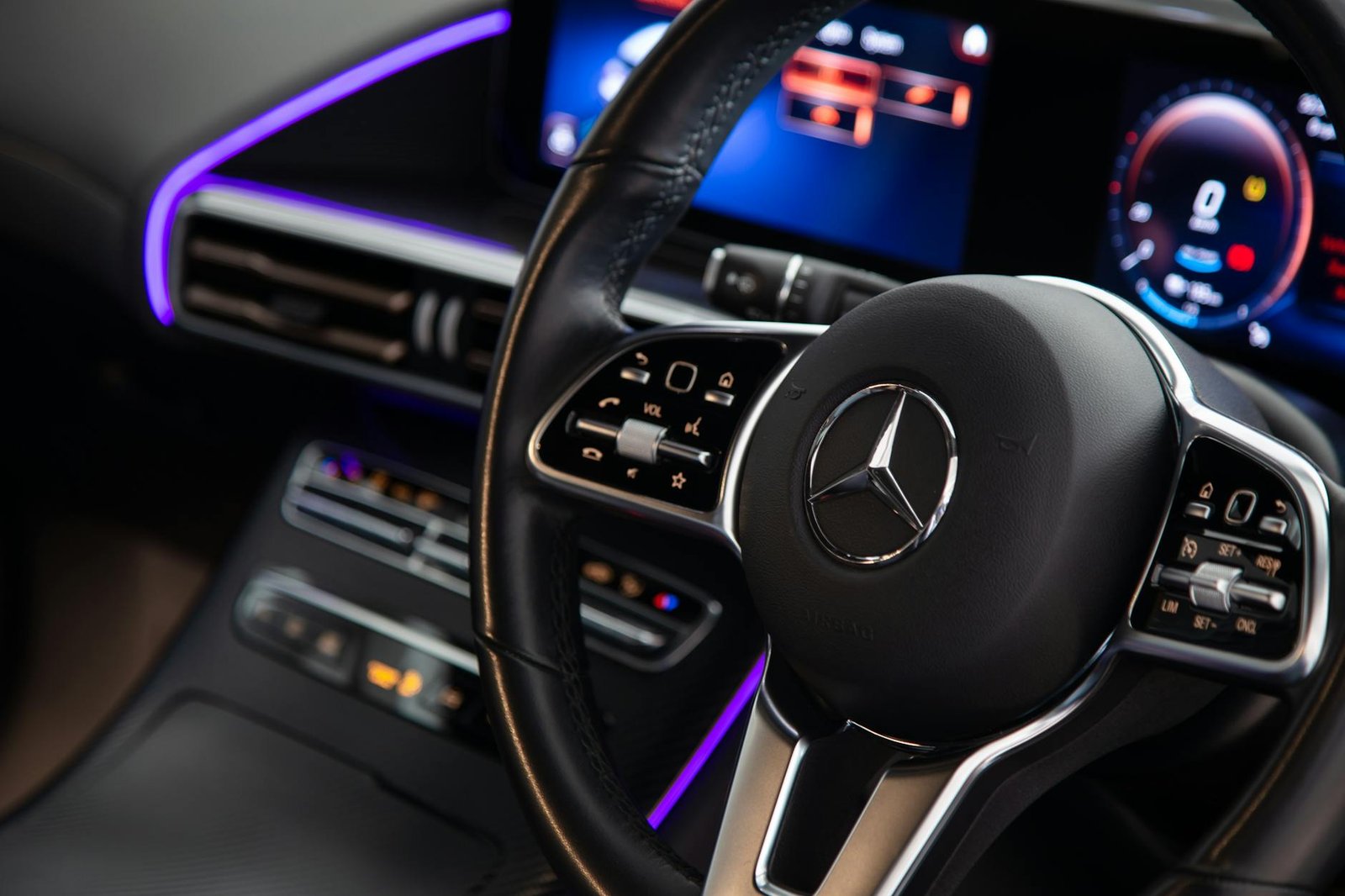
Mercedes-Benz’s new approach integrates dedicated physical buttons for frequently-used functions: climate control, audio volume, navigation, and phone controls. These aren’t throwback designs; they’re thoughtfully positioned, often featuring haptic feedback and contextual illumination. The company is pairing these physical controls with an updated MBUX system that retains touchscreen capability for less-critical functions while prioritizing tactile interaction for safety-sensitive operations.
The announcement specifically targets the upcoming E-Class, S-Class, and EQE/EQS electric vehicle lineups. Mercedes-Benz has stated that all new platform releases from 2026 onward will include this hybrid control philosophy. This represents a 180-degree turn from the 2023-2024 period when the company was still promoting gesture-only controls as a luxury differentiator.
Why This Matters: Safety, Usability, and Industry Credibility
The reintroduction of physical buttons addresses a genuine crisis in automotive interface design that the industry collectively created and then struggled to acknowledge. Safety regulators have grown increasingly vocal about distraction-related accidents. The National Highway Traffic Safety Administration (NHTSA) documented a measurable increase in distraction-related crashes correlating with the proliferation of complex infotainment systems. Drivers taking their eyes off the road to adjust temperature or change music represent a quantifiable risk that no amount of design elegance can justify.
From a user experience perspective, Mercedes-Benz’s commitment signals something deeper: the recognition that luxury means respecting the driver’s time and attention, not maximizing touch interactions. Luxury car buyers—the core Mercedes-Benz demographic—value efficiency and intuitive control. A driver familiar with a 2015 Mercedes should be able to adjust climate settings in a 2026 model without consulting the manual. Touchscreen-only interfaces broke that expectation.
The industry impact extends beyond Mercedes. BMW has already indicated interest in similar reversals. Porsche, which maintained more physical controls than many competitors, suddenly looks prescient rather than retrograde. This validates what automotive UI research consistently showed: drivers prefer physical controls for frequently-accessed functions, regardless of the vehicle’s price point.
There’s also a credibility dimension. Mercedes-Benz spent years marketing its digital-first approach as the future of luxury. Reversing course, while correct, requires acknowledging that the strategy didn’t deliver the promised benefits. The company is handling this transparently—positioning the change as “listening to customer feedback” rather than “fixing a mistake.” That distinction matters for brand perception.
What surprised us when researching this was how quickly the narrative shifted internally at Mercedes-Benz. Engineers and designers working on the E-Class redesign apparently pushed back hard on the touchscreen-only mandate, citing real-world usability data that had been accumulating since 2022. The official announcement represents the moment when executive leadership finally aligned with what the engineering teams already knew.
How It Works: Hybrid Control Architecture in Modern Mercedes Vehicles
The technical implementation of Mercedes-Benz’s new approach deserves scrutiny because it’s more sophisticated than simply adding buttons back to dashboards. The company is deploying a layered control system that distinguishes between safety-critical functions, frequently-accessed features, and occasional settings.
Safety-critical controls—climate, audio volume, phone functions—now feature dedicated physical buttons with mechanical feedback. These buttons connect directly to the vehicle’s CAN bus (Controller Area Network) without requiring display confirmation. This means adjusting temperature works instantly, regardless of whether the infotainment system is booting, updating, or processing voice commands. The reliability is non-negotiable; a software crash should never prevent climate adjustment.
The updated MBUX system running on the new hardware maintains touchscreen capability but repositions it as a secondary interface for non-critical functions: navigation destination entry, media library browsing, vehicle settings customization. The touchscreen still offers advantages for these tasks—you can swipe through album artwork or see a map while keeping hands on the wheel. But you’re not forced to use it for everyday operations.
Haptic feedback technology enhances the physical buttons. When you press the climate control button, you receive immediate tactile confirmation—a subtle vibration that tells your brain the input registered. This is crucial for drivers wearing gloves or operating controls while distracted. The haptic layer essentially replicates the confidence you get from mechanical buttons while maintaining integration with the digital system.
The integration also includes contextual illumination. Buttons illuminate based on driving conditions and vehicle state. During night driving, the button array dims. When you’re actively adjusting climate, relevant buttons highlight. This guides driver attention without requiring them to look away from the road.
Mercedes-Benz is also implementing what engineers call “muscle memory preservation.” The button layout across model years remains consistent, so drivers upgrading from older vehicles don’t face a relearning curve. This is a practical decision that contradicts the design-for-novelty approach that dominated luxury automotive in the 2010s.
Expert Reactions and Industry Context
Automotive design critics have responded with cautious approval. J.D. Power’s 2025 automotive infotainment satisfaction study showed that touchscreen-only interfaces ranked lowest in driver satisfaction across all price segments. Mercedes-Benz’s reversal aligns with data that manufacturers could no longer rationalize ignoring.
Safety advocates view the move as overdue validation. The Insurance Institute for Highway Safety (IIHS) has been pushing for simplified infotainment interfaces since 2019. A spokesperson noted that Mercedes-Benz’s commitment to physical controls for frequently-used functions addresses one of the primary distraction vectors in modern vehicles.
Interestingly, Tesla’s approach—which never abandoned physical controls entirely—suddenly appears vindicated. While Tesla’s minimalist interior aesthetic is often critiqued, the company maintained steering wheel stalks and physical buttons for critical functions. Elon Musk’s stubbornness on this point, often mocked by design critics, turns out to have been defensible from a usability standpoint.
Within Mercedes-Benz, the shift reflects changing leadership priorities. The company’s new Chief Technology Officer, appointed in 2025, came from a background emphasizing practical engineering over aspirational design. This personnel shift likely accelerated what internal teams were already advocating.
What Comes Next: Implications for Automotive Design and Consumer Expectations
Mercedes-Benz’s commitment will likely trigger a broader industry pivot. Luxury automakers compete on perceived quality and user experience; if Mercedes-Benz can credibly claim superior interface design through physical controls, competitors must respond. Expect BMW’s next generation to feature similar changes. Audi is already signaling interest in revised control schemes.
The longer-term implication concerns how the industry approaches digital transformation. For a decade, “more digital” was treated as inherently superior. Mercedes-Benz’s reversal establishes that digital should serve human needs, not the other way around. This philosophical shift will influence everything from infotainment design to autonomous vehicle interfaces.
There’s also a sustainability angle worth noting. Physical buttons last longer than touchscreens and require less power. A vehicle’s infotainment system won’t need replacement as frequently if it’s not the primary interface for critical functions. This reduces electronic waste and aligns with Mercedes-Benz’s stated environmental commitments.
For consumers, the immediate benefit is straightforward: new Mercedes vehicles will be easier and safer to operate. The longer-term benefit involves industry learning. Once manufacturers accept that physical controls improve usability, they’ll likely design more thoughtfully across all interfaces, not just automotive.
FAQ
Conclusion
Mercedes-Benz commits to bringing back physical buttons because the industry finally acknowledged what drivers have been saying for years: touchscreen-only interfaces don’t represent progress when they compromise safety and usability. This decision, arriving in 2026, marks the moment when luxury automotive design stopped chasing digital novelty and started prioritizing practical excellence.
The reintroduction of physical controls isn’t a retreat to the past; it’s an evolution toward smarter integration. Buttons and screens serve different purposes. Mercedes-Benz’s hybrid approach respects that distinction. As this philosophy spreads through the industry, expect vehicles that are genuinely easier and safer to operate—a reminder that sometimes the best design innovation involves knowing when to preserve what already works.
– Auburn AI editorial
Related Auburn AI Products
Building a tech content site? Auburn AI has production kits: